
Introduction
The Stakeholder Negotiation Simulation is a short-form experiential learning activity that helps students develop innovation and entrepreneurial competences while engaging deeply with course content.
Students are introduced to a proposed solution based on prior course content, such as a policy, technology, intervention, or governance approach, and explore how it performs when placed within a realistic social, economic, environmental, or institutional context. Representing different stakeholder groups, students negotiate priorities, resources, constraints, and trade-offs in order to develop a more realistic and implementable pathway forward.
The method is aimed at educators who want to embed innovation and entrepreneurship skills into existing courses without turning them into entrepreneurship courses.
How the Simulation Game Works
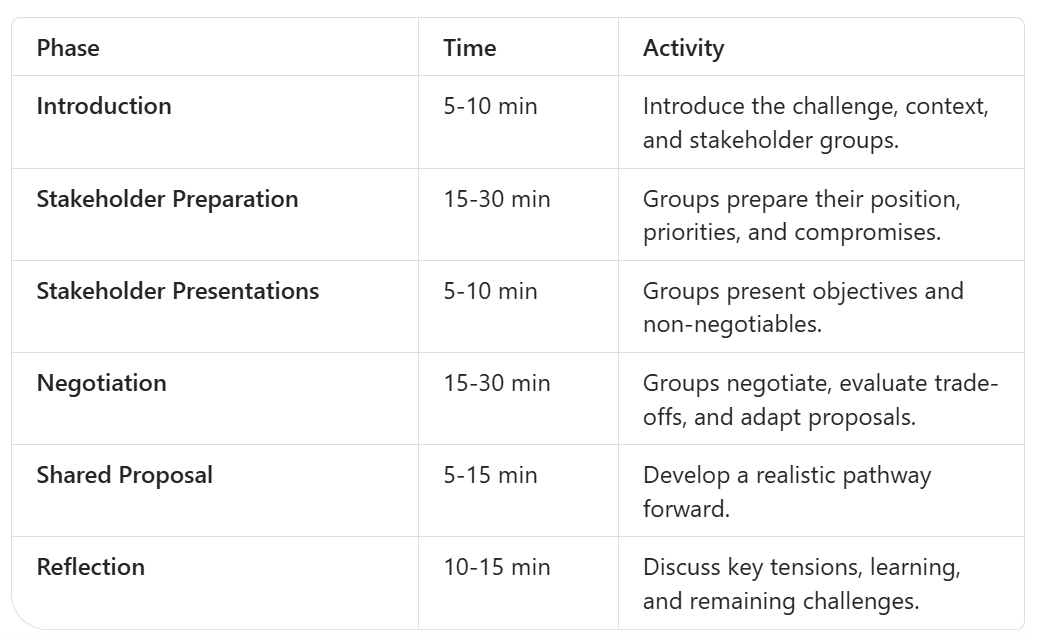
Students are divided into stakeholder groups and presented with a realistic challenge connected to course content. Each stakeholder receives a role describing their objectives, resources, constraints, and areas where compromise may be possible. The simulation begins with a proposed solution, such as a policy, technology, intervention, or organisational approach, placed within a realistic context. Rather than creating solutions from scratch, students explore how the proposed solution would function in practice.
The activity consists of three phases:
1. Stakeholder Preparation
Stakeholder groups review the case, discuss their objectives, identify non-negotiables, and prepare a negotiation strategy. They are encouraged to use relevant course concepts, theories, and evidence to support their position.
2. Negotiation
Stakeholder groups meet to negotiate a pathway forward. As competing interests, resource constraints and practical challenges emerge, students must adapt proposals, evaluate trade-offs and identify compromises that remain acceptable to all parties.
3. Reflection
The simulation concludes with a facilitated discussion in which students reflect on how the proposed solution changed, which tensions emerged, and what they learned about implementation, innovation, and creating change in complex systems.
Outcome
By the end of the simulation, students have developed a stakeholder-informed proposal that is more realistic, implementable and context-sensitive than the original solution. More importantly, they have experienced how innovation often emerges through negotiation, adaptation, and compromise rather than through idea generation alone.
Why Use This Method?
The Stakeholder Negotiation Simulation can be applied to almost any course topic.
Rather than asking students to innovate from a blank page the method starts with existing course content, such as a theory, technology, policy, intervention or professional practice and treats it as a potential solution to a real-world challenge. Students are then asked to explore what would need to happen for that solution to work in practice.
By introducing stakeholders, constraints, competing priorities and contextual complexity, the simulation helps students apply theory while developing innovation and entrepreneurial competences. As they navigate tensions and implementation challenges they gain experience with systems thinking, negotiation, creativity and problem-solving.
The structured starting point makes the activity particularly well suited to time-limited teaching formats. Instead of spending time generating ideas from scratch, students focus on adapting, improving and implementing solutions within realistic constraints.
This makes the method especially useful for educators who want students to gain experience with innovation and entrepreneurship without redesigning their course around entrepreneurship or innovation theory.
The method helps students learn to:
- Identify opportunities hidden within stakeholder tensions
- Evaluate trade-offs and competing priorities
- Navigate uncertainty and incomplete information
- Mobilise support around proposed actions
- Develop realistic compromises
- Adapt solutions to fit contextual realities
- Reflect on their ability to contribute to change
Stand-Alone Activity or Part of a Larger Innovation Journey
The Stakeholder Negotiation Simulation can be used as a stand-alone activity to develop innovation and entrepreneurial competences.
It can also be integrated into a longer innovation learning process.
For example, students may first:
- Explore a problem
- Identify needs and opportunities
- Develop a solution
The simulation game can then be used to help students:
- Test the solution in a realistic context
- Explore stakeholder responses
- Identify implementation barriers
- Adapt and improve the solution
EntreComp Alignment
A well-designed Stakeholder Negotiation Simulation can support the development of the following EntreComp competencies.
EntreComp: The entrepreneurship competence framework – Joint Research Centre
Ideas & Opportunities
- 1.1 Spotting Opportunities: Identifying opportunities and challenges within complex systems
- 1.2 Creativity: Developing adaptations, compromises and alternative approaches
- 1.3 Vision: Exploring desirable futures and pathways for change
- 1.4 Valuing Ideas: Evaluating, refining and selecting among competing proposals
- 1.5 Ethical and Sustainable Thinking: Considering long-term consequences, trade-offs and multiple stakeholder perspectives
Resources
- 2.2 Mobilising Resources: Recognising how resources, capabilities and constraints shape solutions
- 2.5 Mobilising Others: Building support, persuading others and communicating ideas effectively
Into Action
- 3.2 Planning and Management: Developing realistic pathways towards implementation
- 3.3 Coping with Uncertainty, Ambiguity and risk: Navigating incomplete information and competing interests
- 3.4 Working with Others: Negotiating and collaborating across perspectives
- 3.5 Learning Through Experience: Reflecting on decisions, outcomes and assumptions.